


About Rice
The Scientific Name of Rice is as follows:
- Oryza sativa Linnaeus = Asian Rice
- Oryza sativa ssp. indica = Indian Rice
- Oryza sativa ssp. japonica = Japanese Rice
- Oryza sativa ssp. javanica = Japanese Rice
- Oryza glaberrima Steudel = African rice
Variety of Rice - Worldwide there are more than 40,000 different varieties of rice available, species name Oryza sativa. Here are some of the common and popular varieties from India.
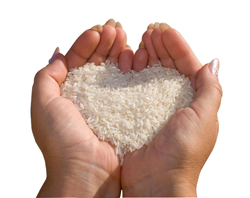 Basmati rice, Ambemohar, Dubraj rice, Aizon Rice, Champaa Rice, Hasan serai, Gobindo Bhog [West Bengal], Atop, Ponni Rice, HMT Rice, Thimmasamundaram Mollakolukulu, Jay Shrirama Rice, Joha rice, Rosematta rice, Navara rice, Raja Hansa rice, Molakolukulu, Patna rice, Tulaipanji rice, Pusa Rice, 74 count, Laxmichura [WestBengal], Bhut Muri(Kelas)[WestBengal], Idly , Rice - Short grain, Sona Masuri, Ranjit Rice, Katta sambar, Hansraj, Jyothi, Annapoornna, Minicate, Super minicate, Poreiton chakhau - aromatic dark red rice from Manipur, Rice varieties of Karnataka- Jaya, Thanu, Tunga, IR-30864, BR-2655 (Produced in SFPP Project, VC Farm, Mandya, Traditional Kerala rice varieties - Chitteni, Aryan, Thavalakkannan, Vattan, Wayanad Kayamma, Palakkad Matta, Assamese rice varieties - Bora, Malbhog, Manuhar, Bahadur, Kushal, Maniram IR-8, etc. Tamilnadu rice varieties- IR-20,IR-50,Aduthurai(ADT)-36,Ambai-16, BPT 5204, ADT 43, improved white ponni, Co-43 etc., Seela Rice, Basmati tukda, Arwa, Parwmal, Surti kolam, kolam (Varieties of Gujrat), Improved Samba Mahsuri, Akshayadhan, Varadhan, Kalinga III, Katarni, Mal-bhog, Tulsi-manjari (black), Mansoori.
History of Rice
Rice is the seed of the monocot plants Oryza sativa (Asian rice) or Oryza glaberrima (African rice). As a cereal grain, it is the most widely consumed staple food for a large part of the world's human population, especially in Asia and the West Indies. It is the grain with the second-highest worldwide production, after maize (corn), according to data for 2010.
 Since a large portion of maize crops are grown for purposes other than human consumption, rice is the most important grain with regard to human nutrition and caloric intake, providing more than one fifth of the calories consumed worldwide by the human species.
Genetic evidence has shown that rice originates from a single domestication 8,200-13,500 years ago, in the Pearl River valley region of China. Previously, archaeological evidence had suggested that rice was domesticated in the Yangtze River valley region in China. From East Asia, rice spread to Southeast and South Asia. Rice was introduced to Europe through Western Asia, and to the Americas through European colonization.
There are many varieties of rice and culinary preferences tend to vary regionally. In the Far East, there is a preference for softer and stickier varieties. Because of its importance as a staple food, rice has considerable cultural importance. Rice is often directly associated with prosperity and fertility. Therefore, there is the custom of throwing rice at weddings.
 Rice is normally grown as an annual plant, although in tropical areas it can survive as a perennial and can produce a ratoon crop for up to 30 years. The rice plant can grow to 1-1.8 m (3.3-5.9 ft) tall, occasionally more depending on the variety and soil fertility. It has long, slender leaves 50-100 cm (20-39 in) long and 2-2.5 cm (0.79-0.98 in) broad. The small wind-pollinated flowers are produced in a branched arching to pendulous inflorescence 30-50 cm (12-20 in) long. The edible seed is a grain (caryopsis) 5-12 mm (0.20-0.47 in) long and 2-3 mm (0.079-0.12 in) thick.
Oryza sativa, commonly known as Asian rice, Rice cultivation is well-suited to countries and regions with low labor costs and high rainfall, as it is labor-intensive to cultivate and requires ample water. Rice can be grown practically anywhere, even on a steep hill or mountain. Although its parent species are native to Asia and certain parts of Africa, centuries of trade and exportation have made it commonplace in many cultures worldwide. The traditional method for cultivating rice is flooding the fields while, or after, setting the young seedlings. This simple method requires sound planning and servicing of the water damming and channeling, but reduces the growth of less robust weed and pest plants that have no submerged growth state, and deters vermin. While flooding is not mandatory for the cultivation of rice, all other methods of irrigation require higher effort in weed and pest control during growth periods and a different approach for fertilizing the soil.
The name wild rice is usually used for species of the grass genus Zizania, both wild and domesticated, although the term may also be used for primitive or uncultivated varieties of Oryza.
